


When I was a kid, pharmacists had their own pharmacies and optometrists had their own eye clinics. Now these models have been replaced by Walgreens and CVS, with EyeMasters and Pearle Vision.
In France they actually have ATM machines for prescriptions. A physician loads the prescription onto a medical card and a patient can pick it up anywhere there is one of these machines. The machine dispenses however many pills the electronic script is written for, puts a sticker on the bottle and drops it into a drawer, the same way you’d grab chips from a vending machine. Prescriptions are now a commodity.
When we go get glasses, most of us don’t care if we look into a machine to tell us we have 20/80 vision because that number goes to a lab tech who crafts the lenses. Most of us are more worried about how the frames look. Glasses are now a commodity.
It’s like “The Jetsons” where a mechanized robot brushes George Jetson’s teeth, shaves his face and dresses him based on a scanner view of his body. What we once thought was futuristic and unattainable is here and now!
All this has me thinking about dentistry’s model and how it’s changing. What will the dental landscape look like in 2050? Will dentistry go the way of Walgreens and EyeMasters? I asked several of my colleagues this question and they shared their opinions, which we feature in this issue (page 64).
Let’s talk about the reality. Dentistry’s unique selling proposition is surgery. We work in an operatory. Our hands and fingers are in someone’s mouth. It’s not the same as a pharmacy or an eye clinic. It takes human hands and human eyeballs to perform dentistry.
Commodities are things you buy on price. When you buy corn, you don’t care if it’s from Iowa or Nebraska. The silliest ad campaign I’ve ever seen is the Florida orange juice one. Have you ever heard anyone at the grocery store asking for Florida oranges because they don’t want the ones from Arizona?
My practice is 25 years old. I have a lot of contacts from Dentaltown who have significant roles in the business to consumer (B to C) marketplace, and we all agree: half of America buys dentistry on price. Some of these people do perceive dentistry as a commodity and some buy on price simply because they don’t have money. If they have bad dental insurance and their insurance says they can only go to one doctor in town, they’ll go to that one doctor in town. This phenomenon is going to be around forever. There are people who are poor who really do value dentistry and there are rich people who don’t value it.
The other half of America has strong opinions about who gets to work in their mouths. The relationship with their provider has a huge impact on their choice of dentist. Have you ever once based whether you want a prescription filled at Walgreens on which pharmacist is going to be there? No! You just want to know when Walgreens is opened and if it has a drive-thru!
The argument is that corporate dentistry fuels the side that says dentistry is a commodity. These companies are representing a brand instead of an individual dentist. They’re often marketing on price, rather than procedure or specialty or dentist. So, yes, there are real-live dentists, not robots, performing the procedures, but it seems to be the beginning of taking the relationship out of the process.
Once you’re 50, you’ve seen everything at least twice, particularly in economics. This is the second time I’ve seen the idea of corporate dentistry come around. Black Monday in 1987 was just months after I graduated dental school. I was practicing during the stock market crash in 2000 and Lehman Brothers fall in 2008. When everyone thinks it’s the end of the world, it’s not. It’s a cycle. We create an economic bubble and then it explodes. It’s just economics.
Corporate dentistry chains have a good grasp on sophisticated marketing and management. When I got out of dental school, not a single dentist I knew, including myself, could use QuickBooks to make payroll. I hadn’t taken one class on management or communication with staff. For some, the answer is: let someone else do it. So if you hate dealing with all things social media and Excel, corporate might be the way to go.
For those who would rather learn it for themselves, check out all the practice management courses on Dentaltown.com. They’re only $18 each. Or, if you want more than a few hour-long classes, maybe you’re interested in going back to school. I went back to school in my 40s! I took two business classes each semester. I attended class on Monday and Wednesday evenings from 6-10 p.m. every week for two years. And I about cried when it was over because I loved it and learned so much! Another solution is to hire street-smart staff—an office manager, specifically. Recognize your limits and delegate!
The other advantages to corporate dentistry are better access to capital and better patient financing. It’s nice not to have to worry about these things. The CAD/CAM unit and other equipment is part of the package and there is no third-party when it comes to financing treatment.
It’s nice to have access to capital and to have patient financing, but you can have these things in a group practice, too. You can split the cost of the rent and the CAD/CAM and the payroll with other partners. You can work with CareCredit for patient financing. So in these ways, I don’t see how a corporate chain in all 50 states is any more competitive than an independent group practice.
I’m not opposed to corporate dentistry. I think it provides needed services for many Americans who need treatment. But unless corporate chains can preserve the one-on-one relationship that a patient gets when he or she visits her independent dentist, I don’t see corporate taking over the dental landscape or dentistry going the way of Walgreens. I think they’ll always be a spot in the marketplace for both private offices and corporate chains. – See more at: http://www.dentaltown.com/Dentaltown/Article.aspx?i=354&aid=4817#sthash.L80fMs9A.dpuf
 When it comes to ethics, most people, dentists included, fall within a midrange. This middle is the silent majority. A normal distribution curve (Fig. 1) says 68.5 percent of people make up the middle ground. The further out from the middle, the fewer the people, but the more extreme. I envision this Ethical Dilemma series sparking conversation on the boards, but chances are only the extreme outliers will argue. This series is meant to start a conversation, not be the world according to Howie! It’s meant to get you thinking and discussing your views and experiences from what you see going on in your practice and in what ways you deal with the ethical issues that arise everyday. Can’t we just have an honest conversation?
 First of all, for this thread to be kicked off by a first-time poster on Dentaltown.com – and that the advice drkinnarshah provided was spot on – thrilled me to no end. When we look at patterns of a successful dental office, practices that have morning huddles do infinitely better in any way you want to measure, whether it’s stress reduction, or increases in productivity and net income. The only thing I want to add to drkinnarshah’s post is to remember, after the morning huddle, it’s imperative to keep in constant contact with the team via walkie-talkies throughout the day.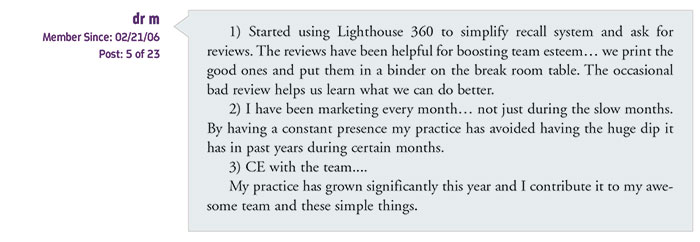
 Dr M’s post is spot on. Everyday since the economy tanked on September 15, 2008, (aka, “Lehman Day”), when asked “If you could have just one magic bullet to improve your practice, what would it be?” four out of every five dentists would say, “I need new patients.” I’m personally proud to say that October 2013 was the best month my practice, Today’s Dental, has ever had in terms of production, collection and new patient intake; I attribute this to two things. The first thing we did was begin nurturing online reviews; this is very powerful. In my neck of the woods, Internet marketing is very strong. We know nine out of 10 appointments are made by women, and more women post online reviews than men do. At my practice, our staff outright asks our patients to post reviews about their positive experiences online. We know that we might receive a negative review from time to time (you can’t please everyone all the time), but if you can drown out any negative review with a ton of positive reviews, you’re doing something right. Our staff hands our patients a card prompting them to say something nice about us, and it’s been a great success.
 For years, I’ve said all leaders are readers, and I’m glad Jen made this recommendation. In my practice, we all read a book a quarter (we’d love to do a book a month, but it is hard to try to find the time to fit a book in each month). I highly recommend getting your team to all read the same business book once a quarter, and discuss it – but, for non-readers, instead of reading the book, you might consider the audio version of it. All non-readers can knock an audiobook out in the same amount of time it takes to do three loads of laundry and mow the lawn. It’s team building and total enrichment for the entire practice.
 I applaud dave27 for implementing new procedures into his practice (it already seems to be paying off for him), and for streamlining his processes to do dentistry faster, cheaper, higher in quality and lower in cost. If you’re burning out in dentistry, start learning new procedures like short-term ortho, or implants, or CAD/CAM.
 Dr. Duke talks about how she set up a private Facebook group for her team and in the thread, Sandy Pardue quotes that as saying that this is the top pick of this entire thread. I have to agree with Sandy, but I am going to have to one-up it a bit. You have to have a communication platform for your team, at Today’s Dental we’ve had our own e-mail platform that has been very effective. The Facebook group Dr. Duke refers to is very interesting; I like that a lot. It’s also why we set up the same kind of platform on Dentaltown.com. Dentaltown’s private groups are far more robust than the Facebook private groups, however, because you can organize them by subjects. I mean you can set something up for hygienists, something for the entire office, something just for insurance or marketing, etc. It’s more organized. But here’s what I like even more: If the dental office staff members are on Facebook in the private Facebook group, they are extremely tempted to hop off that page and go see what all their nieces and nephews and girlfriends are doing. When they are on the Dentaltown.com private group, now when your hygienist, receptionist, assistant or office manager leaves that group she sees three-million other posts by thousands of other dental assistants. And if she gets caught up and lost and distracted in that, she’s still learning about dentistry.


