


In February 2014, Forbes published an article titled “Sears Still Missing the Boat: 6 Ways the Brand Can Be Saved.” Sears has been on a painful decline for the last decade. When I was a kid, Sears was the be-all end-all. It was all things great. I can still remember sitting around with my five sisters looking at the Sears Catalog. We’d circle things. We’d make Christmas lists. It was fantastic.
Sears was one of the first department stores to carry exclusive product lines including DieHard Batteries, Kenmore appliances and Craftsman tools. But now, it’s had its lunch handed to it by Lowes and Home Depot. But why?
The smartest economic gurus in the U.S. and Canadian market insist the market is split in two—half shop on price and half shop on service. But companies, department stores and even dental offices have to have one of the two. They can’t cater to both markets successfully.
For Sears, it used to be all about the service. You knew when you walked into Sears that its product lines were good quality and that you would receive great service if you had any questions or needed help. Now, you walk into Sears and nobody can explain anything about a battery or a tool or an appliance. Its service has taken a plunge but it hasn’t made up for it in price. Other stores, like Wal-Mart for example, have the same products but offer them at a better price.
On the other side of the coin, every time I go into Home Depot and have a question, I get it answered immediately (and of course, realize I need more equipment and tools). I end up being led by the sales associate to four other aisles to find things. It’s good business. That store is staffed with a bunch of people who know what they’re talking about.
This is interesting to me on the dental side of things because I go into dental offices all the time. Nine out of 10 dentists don’t let their staff talk intelligently to patients. Hygienists are afraid to show patients a cavity on an X-ray because they’re “not the doctor.” This is absurd.
The patient is sitting in the chair and the dental assistant is taking a PA and a bitewing for an emergency. The tooth is completely bombed out. It’s obvious that the tooth has to be extracted. The patient asks the dental assistant, who has been working for the practice for years, what the verdict is. She doesn’t answer because she’s afraid of her own doctor. She’s afraid of being knowledgeable staff member. So basically, the doctor wants to be Sears.
I often hear dentists use the excuse: “It’s illegal for a dental hygienist or an assistant to read an X-ray.” Can you name one hygienist, dental assistant or receptionist in America who is serving time in prison for reading an X-ray? It’s not like you, the doctor, are going to go in there and take the hygienist’s reading on the X-ray and just start doing a root canal blindly. No! You are going to evaluate it for yourself. You’re going to ask her to clarify if her handwriting is messy. You’re going to discuss what she saw versus what you’re seeing. This is why the “it’s illegal” excuse is just crazy. It’s crazy for the patient’s questions to be put off and it’s not fair for the staff. They’re knowledgeable, so let them show it in the work they do. The same way the knowledgeable employees at Home Depot take pride in their work, your assistant’s knowledge in the work she does is one of qualities that make her proud to work in your office. And it’s what keeps staff turnover low.
The best thing about having knowledgeable staff is that they’re empowered to do well, which means they’re often the longest-retained employees. Mary at the front desk might not be able to say for sure whether a tooth needs a root canal, but between a little knowledge about what might be causing the patients pain and the fact that she’s been sitting by the doctor’s side for 20 years… patients trust that. It’s selling the invisible.
I continue to hear dentists talk about how they want to operate on service not price. They want to develop a high-end practice. They want to do implants and veneers. It’s interesting to note that these are the same doctors who often come to meetings alone rather than bringing their staff. All I can say is “Where is your team!?” Where is the person answering the phone at your practice? The person who answers the phone should be sitting in a class on ortho or perio or root canals or gum disease. That person is going to be fielding 90 percent of the questions. That incoming call is one of the most powerful things in dentistry.
The greatest stores (those that are continuing to be successful in this economy) are all adding new services. Nordstrom added Topshop. Macy’s expanded their shoe department and partnered with Finish Line. They’re also continuing to train long-term staff to be knowledgeable. The workers know the brands inside and out. They offer specialty services like tailoring and personal shopping. Or in Home Depot’s case, tool rental and installation offerings. They’re differentiating themselves through staff as well as product and service offerings.
You need knowledgeable workers. Our team has busted our butts for 15 years to develop our online CE program. All you need to do is spring for a pizza or sandwiches and you can sit around a table for an hour at lunchtime with your team and watch a CE on Dentaltown. Right now we have about 215 courses online. You could watch one a week for four years and still not finish them! These courses are particularly great because they’re only an hour long (which is about how long our attention spans work effectively). You need knowledgeable workers. You shouldn’t be watching these courses alone. You shouldn’t be learning alone!
There is a lot to be learned from Sears. The failing department store and the stores that are thriving have one big difference—knowledgeable staff. So, which model are you going to follow?
See more at: http://www.dentaltown.com/Dentaltown/Article.aspx?i=360&aid=4903#sthash.i3uf3H4E.dpuf

 First of all, for this thread to be kicked off by a first-time poster on Dentaltown.com – and that the advice drkinnarshah provided was spot on – thrilled me to no end. When we look at patterns of a successful dental office, practices that have morning huddles do infinitely better in any way you want to measure, whether it’s stress reduction, or increases in productivity and net income. The only thing I want to add to drkinnarshah’s post is to remember, after the morning huddle, it’s imperative to keep in constant contact with the team via walkie-talkies throughout the day.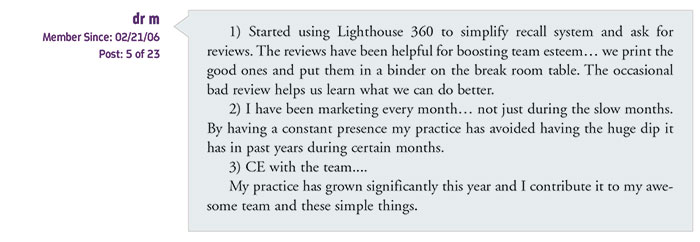
 Dr M’s post is spot on. Everyday since the economy tanked on September 15, 2008, (aka, “Lehman Day”), when asked “If you could have just one magic bullet to improve your practice, what would it be?” four out of every five dentists would say, “I need new patients.” I’m personally proud to say that October 2013 was the best month my practice, Today’s Dental, has ever had in terms of production, collection and new patient intake; I attribute this to two things. The first thing we did was begin nurturing online reviews; this is very powerful. In my neck of the woods, Internet marketing is very strong. We know nine out of 10 appointments are made by women, and more women post online reviews than men do. At my practice, our staff outright asks our patients to post reviews about their positive experiences online. We know that we might receive a negative review from time to time (you can’t please everyone all the time), but if you can drown out any negative review with a ton of positive reviews, you’re doing something right. Our staff hands our patients a card prompting them to say something nice about us, and it’s been a great success.
 For years, I’ve said all leaders are readers, and I’m glad Jen made this recommendation. In my practice, we all read a book a quarter (we’d love to do a book a month, but it is hard to try to find the time to fit a book in each month). I highly recommend getting your team to all read the same business book once a quarter, and discuss it – but, for non-readers, instead of reading the book, you might consider the audio version of it. All non-readers can knock an audiobook out in the same amount of time it takes to do three loads of laundry and mow the lawn. It’s team building and total enrichment for the entire practice.
 I applaud dave27 for implementing new procedures into his practice (it already seems to be paying off for him), and for streamlining his processes to do dentistry faster, cheaper, higher in quality and lower in cost. If you’re burning out in dentistry, start learning new procedures like short-term ortho, or implants, or CAD/CAM.
 Dr. Duke talks about how she set up a private Facebook group for her team and in the thread, Sandy Pardue quotes that as saying that this is the top pick of this entire thread. I have to agree with Sandy, but I am going to have to one-up it a bit. You have to have a communication platform for your team, at Today’s Dental we’ve had our own e-mail platform that has been very effective. The Facebook group Dr. Duke refers to is very interesting; I like that a lot. It’s also why we set up the same kind of platform on Dentaltown.com. Dentaltown’s private groups are far more robust than the Facebook private groups, however, because you can organize them by subjects. I mean you can set something up for hygienists, something for the entire office, something just for insurance or marketing, etc. It’s more organized. But here’s what I like even more: If the dental office staff members are on Facebook in the private Facebook group, they are extremely tempted to hop off that page and go see what all their nieces and nephews and girlfriends are doing. When they are on the Dentaltown.com private group, now when your hygienist, receptionist, assistant or office manager leaves that group she sees three-million other posts by thousands of other dental assistants. And if she gets caught up and lost and distracted in that, she’s still learning about dentistry.


